

How I Hyperfocus On Demand Using Neuroscience
The ADHD Guide to Flow State: 6 evidence-informed strategies to stop fighting your attention and start working with it. Heads up: it's a deep dive.

Hello! Quick note before we start: I’m thrilled to announce that I’m an invited speaker and panelist at Shimmer’s ADHD Growth Summit this August! Use this link to learn more and secure your spot for 6 days of ADHD-Focused expert wisdom. Can’t wait to see you there!

Hyperfocus Or Flow State? What Are They? And What’s The Difference?
If you have ADHD, you’ve probably experienced both extremes.
One moment you’re staring at a task, completely unable to start.
The next, you blink and realize you’ve somehow spent four hours researching whether whale song counts as a language. It’s now 2 a.m.; you’ve forgotten to drink water, missed 11 text messages, and accidentally skipped dinner.
This paradox confuses both people with ADHD and the people around them. If ADHD is an attention deficit, how can we sometimes focus so intensely that the rest of the world disappears?
You’ll often hear skeptics say things like, “Well, if you can play video games for six hours straight, you clearly don’t have an attention deficit.”
But that’s based on a misunderstanding of what ADHD actually is.
ADHD isn’t really a deficit of attention—it’s primarily a difficulty regulating attention. We don’t get to choose as easily what our attention latches onto, when it lets go, or how long it stays there. Sometimes it slips away from us when we desperately want to focus, and other times it locks on so tightly that we forget the rest of the world exists.
One of the most fascinating forms of attention is something psychologists call flow. Coined by psychologist Mihaly Csikszentmihalyi, flow describes a state of complete immersion in a task. Time seems to disappear, distractions fade into the background, and your actions feel almost effortless. You’re no longer forcing yourself to concentrate—you’re simply in it. Athletes describe it as being “in the zone”; musicians lose themselves in their performance; writers suddenly look up and realize three hours have passed.
Researchers have found that flow tends to emerge when there’s a balance between challenge and skill. The task has to be difficult enough to keep you engaged, but not so difficult that it becomes overwhelming. Psychologists call this a skill-challenge match.
Now, flow and ADHD hyperfocus aren’t exactly the same thing…
Flow is generally thought of as a positive state. It tends to be productive, fulfilling, and directed toward meaningful goals. Hyperfocus, on the other hand, is more neutral. It can look like flow—we might spend hours making progress on a creative project or finally tackling that assignment we’ve been avoiding. But it can also hijack our attention in less helpful ways. We’ve all lost an afternoon to doomscrolling, reorganizing our Spotify playlists, or picking at our skin without even realizing how much time has passed.
Most of us would like a little more of the first kind and a little less of the second.
So in this post, I’m going to share five evidence-informed strategies that help me create the conditions for flow—even with ADHD—plus a few tips for snapping out of hyperfocus when it’s no longer serving you.
A Quick Note On The Neuroscience
Before we dive into the tips, I want to give you a very simplified overview of what’s happening in the brain.
Attention isn’t controlled by just one system. Dopamine, norepinephrine, your emotional state, motivation, and the executive functions of your prefrontal cortex all work together to determine whether you stay focused or get distracted.
I could happily spend the next 3,000 words nerding out about all of them—but for this post, we’re going to focus on just one: the locus coeruleus-norepinephrine (LC-NE) system. I like to think of it as your brain’s attention thermostat.
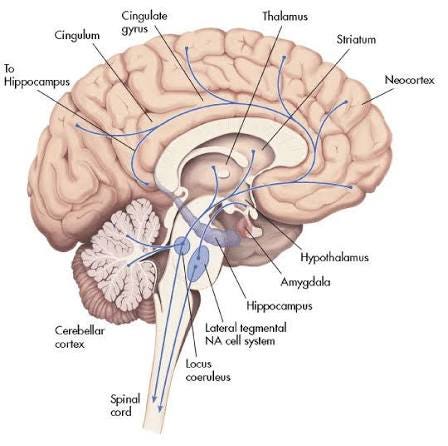
If activity in this system is too low, you’re likely to feel bored, restless, and distracted. Too high, and you’re more likely to feel anxious, stressed, or mentally overloaded. But somewhere in the middle lies the sweet spot: alert enough to stay engaged, but calm enough to think clearly. That’s where flow is most likely to emerge.
If you’ve read some of my previous posts, you’ve probably come across the Yerkes-Dodson Law. Imagine an upside-down U.
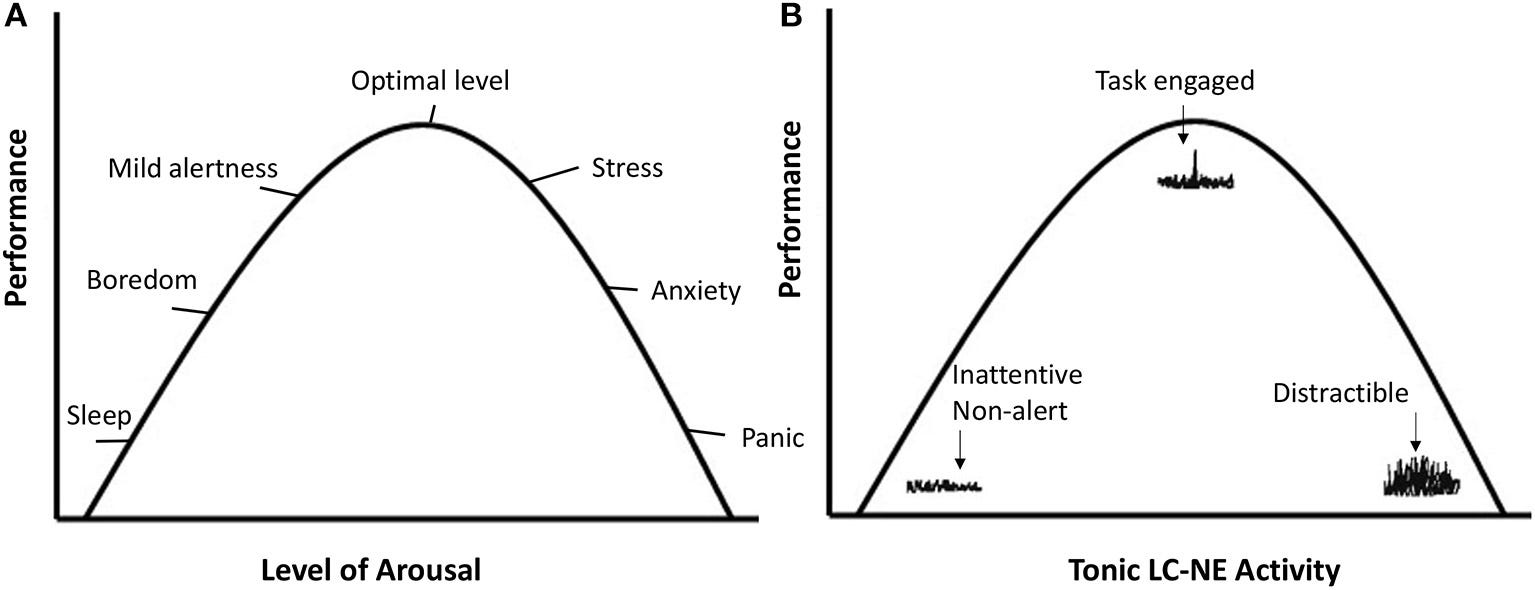
On the left side, you’re underaroused. You’re bored, restless, craving stimulation, and your attention keeps wandering.
On the right side, you’re over-aroused. You’re stressed, overwhelmed, anxious, and your brain feels like it’s trying to juggle twenty tabs at once.
Right at the peak of the curve is what’s known as your optimal arousal zone. This is where you’re alert enough to stay engaged, but calm enough to think clearly. Conveniently, this is also where flow is most likely to emerge.
The LC-NE system is thought to play an important role in helping your brain find this sweet spot.
When background (or tonic) norepinephrine activity is too low, your brain starts scanning the environment for something more interesting. When it’s too high, attention becomes fragmented, and stress increases. But somewhere in the middle, the brain switches into a mode where brief bursts of norepinephrine (called phasic activity) help you stay locked onto what’s right in front of you.
This idea forms the basis of Adaptive Gain Theory, proposed by neuroscientists Aston-Jones and Cohen, and it fits remarkably well with what psychologists have been describing for decades in flow research: we perform best when we’re neither bored nor overwhelmed, but appropriately challenged. It’s a sort of Goldilocks Zone of arousal, providing the perfect conditions for sustained attention.
As you’ll see, almost every strategy in this post is really just a different way of nudging your brain back toward that sweet spot.
How To Train Flow
1. Mindfulness Training
Don’t scroll away just yet…I know you’re probably sick of hearing about mindfulness and meditation, and you’re convinced it doesn’t work for you because you can’t “clear your mind.”Just hear me out.
The biggest misconception about mindfulness is that it’s about staying perfectly calm and focused for as long as possible. It’s not.
In fact, I need you to stop thinking of mindfulness as focus training and start thinking of it as attention recovery training. Or better yet, attention rehab. Every time you notice that your mind has wandered and gently bring it back, you’re strengthening your attentional control.
The goal isn’t to stop distractions from happening; that’s impossible. In fact, your brain is supposed to notice changes in your environment. If it didn’t, you’d completely miss important things happening around you — both the dangers and the potential rewards. The goal is to reduce the amount of time between being distracted and being locked onto your task.
Think of it like doing reps at the gym: the exercise isn’t staying focused; it’s catching your attention when it wanders and bringing it back…Over and over again. For ADHD brains, that “return” practice is often more important than being able to sustain attention indefinitely.
There’s another reason mindfulness can help with flow. Most mindfulness practices ask you to focus on an anchor—usually your breath. A hallmark of flow is becoming deeply immersed in a single activity. By repeatedly returning your attention to the breath, you’re practising exactly that: engaging deeply with one thing at a time. The breath itself isn’t magical (although read below to see how it can be super helpful). It just happens to be a convenient target that’s always available.
Over time, you become better at anchoring your attention wherever you choose it to be—whether that’s your breathing, your textbook, your laptop, or the conversation you’re having.
The ability to intentionally return and re-anchor your attention is one of the foundations of entering flow.
2. Breathwork
It probably won’t surprise you to hear that our breathing changes depending on how we’re feeling. Think about it: when you’re anxious, your breathing becomes quicker and shallower. When you’re relaxed, it naturally slows down. What’s really fascinating is that this relationship goes both ways. By intentionally changing the way you breathe, you can also influence your level of alertness and arousal. Emotion researchers have known this for a long time. But what about attention? It’s pretty similar to emotion, right?
I became so fascinated by this idea that I wrote my neuroscience master’s thesis on breathing patterns and sustained attention, and even spent nine months conducting my own neuroscience study on the topic.
My own experiment didn’t produce a statistically significant effect, so it’s not like I could recommend the exact protocol I was studying and say it worked. But diving into the existing literature and conducting my experiment did, however, teach me an enormous amount about how breathing interacts with attention. One of my biggest takeaways was that breathwork probably isn’t an on/off switch for focus. It’s more like a dial that nudges your brain toward a different attentional state. Whether you practice breathwork consciously or not, your brain will, at some point, adjust your breathing to match your situation.
A quick note: If you have asthma, COPD, other respiratory conditions, panic disorder, or a history of panic attacks, please speak to your healthcare provider before experimenting with structured breathwork.
There are two approaches I love, and I actually think they work best together.
The Super-Personal Approach
The next time you naturally find yourself in flow, get curious. How are you breathing? Is it fast or slow? Deep or shallow? Are your inhales longer than your exhales? You probably won’t notice in the moment, but afterwards try to reflect on what your breathing felt like while you were “in the zone.”
Then, the next time you’re about to start a deep work session, experiment with gently recreating that breathing pattern and see whether it helps you settle into the task more quickly.
Your optimal rhythm might not look exactly like anyone else’s.
The Research-Based Approach
This is based on all the background research I did for my master’s thesis — but like I said, my experiment did not yield statistically significant results, so even though I personally find my protocol helpful, that could actually be a placebo effect. Either way, more research is needed before I make any bold claims, but it’s low risk and worth a shot, so if it works for you as well, then that’s cool!
Earlier, we talked about the Yerkes-Dodson curve—the idea that flow tends to happen when we’re neither under-aroused nor overwhelmed, but sitting somewhere in the middle.
Interestingly, breathing appears to communicate with many of the same brain regions involved in attention, emotion, and alertness, including the LC-NE system.
Research suggests that inhalation is generally associated with increased alertness and sensory processing, while exhalation tends to promote relaxation. That’s why breathing exercises for sleep or anxiety often make the exhale much longer than the inhale.
But for flow, we’re not trying to become deeply relaxed. We’re aiming for something different: calm alertness.
That’s why I personally prefer breathing rhythms where the inhale and exhale are relatively balanced instead of dramatically extending the exhale.
For me, that looks like:
Inhale for 2 counts
Hold for 1 count
Exhale for 3 counts
I find that this leaves me feeling focused without making me sleepy. That said, I wouldn’t get too attached to my numbers. The goal isn’t to copy my breathing exactly—it’s to experiment until you find the rhythm that leaves you feeling alert, calm, and ready to engage.
One important thing: breathing isn’t meant to be controlled indefinitely. Our breathing naturally changes from moment to moment depending on what we’re doing, thinking, and feeling. I usually practise a structured breathing pattern for about two minutes before I start working, then let my breathing return to whatever feels natural. Think of it as gently nudging your brain toward the optimal arousal zone rather than trying to hold it there by force.
3. Meet Your Needs
Most people think of productivity and focus as purely psychological, but your brain doesn’t separate your mind from your body. Your brain is constantly monitoring for unmet needs. Hunger, thirst, fatigue, pain, temperature, discomfort—these all compete for your attentional resources.
If you’ve ever spent half an hour trying to focus, only to realize you haven’t eaten since breakfast, you’ve experienced this firsthand.
Before you start a deep work session, do a quick systems check.
Ask yourself:
Have I eaten in the last four hours?
Do I have water nearby?
Have I gone to the bathroom?
Am I too hot or too cold?
Is there anything likely to interrupt me?
Five minutes of preparation can save you thirty minutes of fighting your brain.
One of my favourite ways to do this is with a quick body scan meditation. Spend two to five minutes mentally checking in with yourself from head to toe. Notice any tension, discomfort, or signals your body is trying to send you before you ask your brain to focus. This can be especially helpful if you have ADHD.
Research suggests that people with ADHD often have more difficulty with interoception—the ability to notice and interpret what’s happening inside the body. We might not realise we’re hungry until we’re starving, or notice we’re thirsty only once we have a headache. It doesn’t mean our bodies aren’t sending the signals; it just means we’re more likely to miss them. Like any skill, though, interoception can be practised.
A simple acronym I like to use is HUTS:
Hungry
Upset
Tired
Stressed
Whenever I notice myself getting distracted, overwhelmed, or inexplicably unproductive, I do a quick HUTS check before assuming I just “can’t focus.”
4. Pacify Your “Floating Attention”
I like to think of our attention as having two different modes. The first is focused attention. This is like a spotlight. It’s the part of your brain that’s locked onto the thing you’re actually trying to do. The second is what I like to call floating attention. Think of it as a radar that’s constantly scanning your environment for anything new, interesting, rewarding, or potentially threatening.
Now, to be clear, this isn’t official neuroscience terminology— but if you’re interested, we can chat more about executive functions, the default mode network, and other cool brain stuff soon —it’s just a mental model I find really helpful.
If you have ADHD, that floating attention radar can be very enthusiastic. It keeps looking around for something more interesting. A notification. Someone walking past. A conversation in the hallway. That weird mark on your desk you’ve never noticed before.
One reason I think subtle background stimulation can be so helpful is that it gives this “floating attention” something harmless to latch onto, freeing up your focused attention to stay on the task. It’s a bit like giving a toddler a colouring book while you’re trying to have an adult conversation. The trick is that the stimulation has to stay in the background. If it starts demanding your attention, you’ve just created a second distraction.
Some of my favourite options are:
a simple fidget toy
chewing gum
rain sounds or brown noise
instrumental music
an under-desk walking pad
Experiment and find what works for you. The goal isn’t to overwhelm your brain with stimulation—it’s to give it just enough that it stops searching for something else. I like to think of it as giving your floating attention a pacifier. Once it’s content, your focused attention can finally take the wheel.
5. Have Clear Task Goals
Ambiguity is the enemy of flow.
One of the key ingredients of flow is clarity. When the next action is obvious, your brain can stay engaged. But when it’s ambiguous, your brain starts burning energy trying to figure out what to do next. When you’re in flow, the last thing you want is to keep interrupting yourself with decisions. It requires too much attentional switching.
Instead of jumping straight into a task, start with a brain dump. Get everything that’s swirling around in your head onto paper, then break it down into small, actionable steps. The more specific you are, the easier it is to stay engaged.
Compare these two tasks:
❌ Work on essay. vs. ✅ Write the first 200 words of the introduction.
The second task gives your brain a clear target. There’s very little room for uncertainty or decision-making, so you can just get started.
Flow researchers consistently find that clear goals and immediate feedback are two of the most reliable ingredients for entering flow. Every time you complete one small step, your brain gets a tiny piece of feedback. That keeps your momentum going.
If breaking down tasks doesn’t come naturally to you, don’t worry—it’s a skill you can practise. This shouldn’t be a surprise to you this far down the post. I actually wrote an entire post on how to break overwhelming projects into manageable steps, so if that’s something you struggle with, you can check it out here.
Bonus Tip: Engineer a Skill-Challenge Match
If you’ve made it this far, you’ve probably noticed that almost every strategy in this post is really about one thing: getting your brain into that sweet spot between boredom and overwhelm.
One of the biggest predictors of flow is something psychologists call a skill-challenge match. In other words, the task needs to be just hard enough. Too easy, and your brain gets bored. Your attention starts wandering because it’s looking for something more stimulating. Too difficult, and your brain becomes overwhelmed. The task starts to feel impossible, so you procrastinate, avoid it, or give up altogether. Flow lives in the middle.
So if you’re struggling to get into flow, ask yourself one simple question:
Am I bored, or am I overwhelmed? Your answer tells you what to do next.
If you’re bored, increase the challenge.
Race against the clock.
Turn it into a game.
Add constraints.
Make it collaborative or competitive.
See if you can beat your previous time.
If you’re overwhelmed, reduce the challenge.
Break the task into smaller steps.
Reduce the scope.
Ask for help.
Lower the stakes.
Permit yourself to produce a messy first draft.
One of the most interesting things I observed during my master’s research was that participants reported feeling most focused during the version of the task that was optimally challenging. When the task became too easy, people actually became more distracted and made more mistakes because they were bored. A little bit of challenge turned out to be better than almost no challenge at all.
So the next time you find yourself unable to focus, don’t automatically assume you need more discipline. Sometimes you just need to adjust the difficulty of the task until it lands in that Goldilocks zone where it’s not too easy, not too hard…but just right.
How to Snap Out of Hyperfocus
Flow can be an incredible thing; you make progress, you feel fulfilled, and work starts to feel almost effortless. But…Sometimes we hyperfocus on the wrong thing, and other times we stay hyperfocused for so long that it stops being productive altogether. It becomes unsafe and unhealthy.
Most of us spend our workdays sitting at a desk in front of a screen. If we stay locked into one position for hours, we’re straining our eyes, stiffening our muscles, and ignoring the signals our body has been sending us all along.
Even if you did your HUTS check before you started working, four hours later you might desperately need the bathroom, be dehydrated, or have skipped lunch without even noticing.
Hyperfocus can be incredibly productive in the short term, but if it comes at the expense of your health, it isn’t sustainable. And that’s really what this whole article has been about. Attention regulation isn’t just about getting into flow. It’s also about getting out of it. It’s about having agency over your attention.
The goal isn’t to keep your attention glued to one thing forever. The goal is to direct your attention where you want it to go, keep it there for as long as it’s serving you, and then be able to shift it when it’s time.
That’s one of the reasons I love both mindfulness meditation and body scan meditations. They don’t just help you focus—they help you practise noticing where your attention is, choosing where to direct it, and tuning back into what your body is trying to tell you. In other words, you’re building both attentional control and interoceptive awareness.
Of course, you don’t have to rely on willpower and skills alone — your environment and other tools can help. One of my favourite strategies is to build external boundaries around my focus sessions.
I’ve talked before about modifying the Pomodoro Method by making the focus sessions shorter for boring or difficult tasks, but for deep work, I actually do the opposite. If I know I’m likely to enter flow, I’ll deliberately use a longer timer—usually somewhere between 45 and 90 minutes. That gives me enough time to settle into a deep focus state, while still creating a clear endpoint before I end up four hours deep with a sore back and a full bladder.
Apps like Forest or Focus Friend make this really easy, but I also love using wearable technology. For example, my smartwatch vibrates after I’ve been sitting for 45 minutes, reminding me to stand up and move around. It’s a tiny interruption, but sometimes that’s all it takes to bring my attention back to my body.
You can also use your environment to create stronger cues. If you have smart lights, try setting them on a timer before you start working. At the end of your focus session, have them dim or change colour. Unlike a phone alarm—which is incredibly easy to dismiss without thinking—a sudden change in the room grabs your attention and helps break the spell of hyperfocus.
Another strategy I absolutely love is using social cues. One of my favourite platforms is Focused Space, which hosts live virtual co-working sessions. Before each session, the host guides everyone through a quick focus ritual. At the end, there’s a distinctive bell, followed by a reminder to stand up, drink some water, celebrate what you’ve accomplished, and decide what comes next. If you’d like to try Focused Space and get 20% off your membership forever, then sign up using this link.
Over time, those rituals become cues that train your brain to transition out of deep work instead of staying stuck in it indefinitely.
At the end of the day, the goal isn’t to hyperfocus for as long as humanly possible, but to build a relationship with your attention where you decide where it goes rather than being dragged along by your impulses, your distractions, and your unhealthy habits. That’s what attention regulation really looks like.
Conclusion & Up Next
This was an absolute mammoth of an article to write — so thank you to everyone who made it this far!
Reminder to sign up for the ADHD Growth Summit in August, where I’ll be sharing even more wisdom that got me through 5 years of university!
Coming up next, I’ll be doing a mini-series to celebrate my recent 25th birthday! I’ll be sharing 25 lessons I’ve learned, divided into 5 lessons per post, so subscribe to make sure you don’t miss anything!
Don’t forget to refer a friend so you can earn yourself comp access to my paywalled posts!
3 referrals earn you 1 month comp
5 referrals earn you 3 months comp
25 referrals earn you 6 months comp
As always: stay curious, stay connected, and turn your potential into action.
Sources
Ashhad, S., Kam, K., Del Negro, C. A., & Feldman, J. L. (2022). Breathing Rhythm and Pattern and Their Influence on Emotion. Annual Review of Neuroscience, 45(1), 223–247. https://doi.org/10.1146/annurev-neuro-090121-014424
Aston-Jones, G., & Cohen, J. D. (2005a). Adaptive gain and the role of the locus coeruleus–norepinephrine system in optimal performance. Journal of Comparative Neurology, 493(1), 99–110. https://doi.org/10.1002/cne.20723
Aston-Jones, G., & Cohen, J. D. (2005b). AN INTEGRATIVE THEORY OF LOCUS COERULEUS-NOREPINEPHRINE FUNCTION: Adaptive Gain and Optimal Performance. Annual Review of Neuroscience, 28(1), 403–450. https://doi.org/10.1146/annurev.neuro.28.061604.135709
Bakker, A. B., Oerlemans, W., Demerouti, E., Slot, B. B., & Ali, D. K. (2011). Flow and performance: A study among talented Dutch soccer players. Psychology of Sport and Exercise, 12(4), 442–450. https://doi.org/10.1016/j.psychsport.2011.02.003
Balban, M. Y., Neri, E., Kogon, M. M., Weed, L., Nouriani, B., Jo, B., Holl, G., Zeitzer, J. M., Spiegel, D., & Huberman, A. D. (2023a). Brief structured respiration practices enhance mood and reduce physiological arousal. Cell Reports. Medicine, 4(1), 100895. https://doi.org/10.1016/j.xcrm.2022.100895
Baranes, A. F., Oudeyer, P.-Y., & Gottlieb, J. (2014). The effects of task difficulty, novelty and the size of the search space on intrinsically motivated exploration. Frontiers in Neuroscience, 8. https://doi.org/10.3389/fnins.2014.00317
Brown, R. P., & Gerbarg, P. L. (2005). Sudarshan Kriya Yogic Breathing in the Treatment of Stress, Anxiety, and Depression: Part II—Clinical Applications and Guidelines. The Journal of Alternative and Complementary Medicine, 11(4), 711–717. https://doi.org/10.1089/acm.2005.11.711
Csikszentmihalyi, M. (2000a). Beyond boredom and anxiety (pp. xxx, 231). Jossey-Bass.
Csikszentmihalyi, M. (2000b). FLOW: The Psychology of Optimal Experience.
Csikszentmihalyi, M. (2014). Toward a Psychology of Optimal Experience. In M. Csikszentmihalyi (Ed.), Flow and the Foundations of Positive Psychology: The Collected Works of Mihaly Csikszentmihalyi (pp. 209–226). Springer Netherlands. https://doi.org/10.1007/978-94-017-9088-8_14
Csikszentmihalyi, M., & LeFevre, J. (1989). Optimal experience in work and leisure. Journal of Personality and Social Psychology, 56(5), 815–822. https://doi.org/10.1037/0022-3514.56.5.815
Dunn, A. J., Swiergiel, A. H., & Palamarchouk, V. (2004). Brain Circuits Involved in Corticotropin-Releasing Factor-Norepinephrine Interactions during Stress. Annals of the New York Academy of Sciences, 1018(1), 25–34. https://doi.org/10.1196/annals.1296.003
Engeser, S., & Rheinberg, F. (2008). Flow, performance and moderators of challenge-skill balance. Motivation and Emotion, 32(3), 158–172. https://doi.org/10.1007/s11031-008-9102-4
Gilzenrat, M. S., Nieuwenhuis, S., Jepma, M., & Cohen, J. D. (2010). Pupil diameter tracks changes in control state predicted by the adaptive gain theory of locus coeruleus function. Cognitive, Affective, & Behavioral Neuroscience, 10(2), 252–269. https://doi.org/10.3758/CABN.10.2.252
Gu, S., Wang, W., Wang, F., & Huang, J. H. (2016). Neuromodulator and Emotion Biomarker for Stress Induced Mental Disorders. Neural Plasticity, 2016(1), 2609128. https://doi.org/10.1155/2016/2609128
Jackson, S. A., & Csikszentmihalyi, M. (1999). Flow in Sports. Human Kinetics.
Jackson, S. A., & Eklund, R. C. (2002). Assessing Flow in Physical Activity: The Flow State Scale–2 and Dispositional Flow Scale–2. https://doi.org/10.1123/jsep.24.2.133
Kurzban, R., Duckworth, A., Kable, J. W., & Myers, J. (2013). An opportunity cost model of subjective effort and task performance. Behavioral and Brain Sciences, 36(6), 661–679. https://doi.org/10.1017/S0140525X12003196
Kutscheidt, K., Dresler, T., Hudak, J., Barth, B., Blume, F., Ethofer, T., Fallgatter, A. J., & Ehlis, A.-C. (2019). Interoceptive awareness in patients with attention-deficit/hyperactivity disorder (ADHD). ADHD Attention Deficit and Hyperactivity Disorders, 11(4), 395–401. https://doi.org/10.1007/s12402-019-00299-3
M. Bruton, A., Levy, L., Rai, N. K., Colgan, D. D., & M. Johnstone, J. (2025). Diminished Interoceptive Accuracy in Attention-Deficit/Hyperactivity Disorder: A Systematic Review. Psychophysiology, 62(2), e14750. https://doi.org/10.1111/psyp.14750
Lu, H., van der Linden, D., & Bakker, A. B. (2023). Changes in pupil dilation and P300 amplitude indicate the possible involvement of the locus coeruleus-norepinephrine (LC-NE) system in psychological flow. Scientific Reports, 13(1), 1908. https://doi.org/10.1038/s41598-023-28781-z
Martin, A., & Jackson, S. (2008). Brief approaches to assessing task absorption and enhanced subjective experience: Examining ‘short’ and ‘core’ flow in diverse performance domains. Motivation and Emotion, 32. https://doi.org/10.1007/s11031-008-9094-0
Peifer, C., Schulz, A., Schächinger, H., Baumann, N., & Antoni, C. H. (2014). The relation of flow-experience and physiological arousal under stress—Can u shape it? Journal of Experimental Social Psychology, 53, 62–69. https://doi.org/10.1016/j.jesp.2014.01.009
Perl, O., Ravia, A., Rubinson, M., Eisen, A., Soroka, T., Mor, N., Secundo, L., & Sobel, N. (2019). Human non-olfactory cognition phase-locked with inhalation. Nature Human Behaviour, 3(5), 501–512. https://doi.org/10.1038/s41562-019-0556-z
Ryan, R. M., & Deci, E. L. (2000). Self-determination theory and the facilitation of intrinsic motivation, social development, and well-being. American Psychologist, 55(1), 68–78. https://doi.org/10.1037/0003-066X.55.1.68
Sayalı, C., Heling, E., & Cools, R. (2022). Learning progress mediates the link between cognitive effort and task engagement (p. 2021.12.02.470970). bioRxiv. https://doi.org/10.1101/2021.12.02.470970
Schulkin, J., & Sterling, P. (2019). Allostasis: A Brain-Centered, Predictive Mode of Physiological Regulation. Trends in Neurosciences, 42(10), 740–752. https://doi.org/10.1016/j.tins.2019.07.010
Shirama, A., Takeda, T., Ohta, H., Iwanami, A., Toda, S., & Kato, N. (2020). Atypical alert state control in adult patients with ADHD: A pupillometry study. PLOS ONE, 15(12), e0244662. https://doi.org/10.1371/journal.pone.0244662
van der Linden, D., Tops, M., & Bakker, A. B. (2021a). Go with the flow: A neuroscientific view on being fully engaged. European Journal of Neuroscience, 53(4), 947–963. https://doi.org/10.1111/ejn.15014
van der Linden, D., Tops, M., & Bakker, A. B. (2021b). The Neuroscience of the Flow State: Involvement of the Locus Coeruleus Norepinephrine System. Frontiers in Psychology, 12. https://doi.org/10.3389/fpsyg.2021.645498
Vlemincx, E., Taelman, J., De Peuter, S., Van Diest, I., & Van Den Bergh, O. (2011). Sigh rate and respiratory variability during mental load and sustained attention. Psychophysiology, 48(1), 117–120. https://doi.org/10.1111/j.1469-8986.2010.01043.x
Vlemincx, E., Van Diest, I., & Van den Bergh, O. (2016). A sigh of relief or a sigh to relieve: The psychological and physiological relief effect of deep breaths. Physiology & Behavior, 165, 127–135. https://doi.org/10.1016/j.physbeh.2016.07.004
Weng, H. Y., Feldman, J. L., Leggio, L., Napadow, V., Park, J., & Price, C. J. (2021). Interventions and Manipulations of Interoception. Trends in Neurosciences, 44(1), 52–62. https://doi.org/10.1016/j.tins.2020.09.010
Woźniak-Kwaśniewska, Agata. (2013). Optimisation of repetitive transcranial magnetic stimulation using electroencephalographic measurements in patients suffering from mood disorders.
Zelano, C., Jiang, H., Zhou, G., Arora, N., Schuele, S., Rosenow, J., & Gottfried, J. A. (2016). Nasal Respiration Entrains Human Limbic Oscillations and Modulates Cognitive Function. Journal of Neuroscience, 36(49), 12448–12467. https://doi.org/10.1523/JNEUROSCI.2586-16.2016
Zhang, Q., Chen, X., Zhan, Q., Yang, T., & Xia, S. (2017). Respiration-based emotion recognition with deep learning. Computers in Industry, 92–93, 84–90. https://doi.org/10.1016/j.compind.2017.04.005